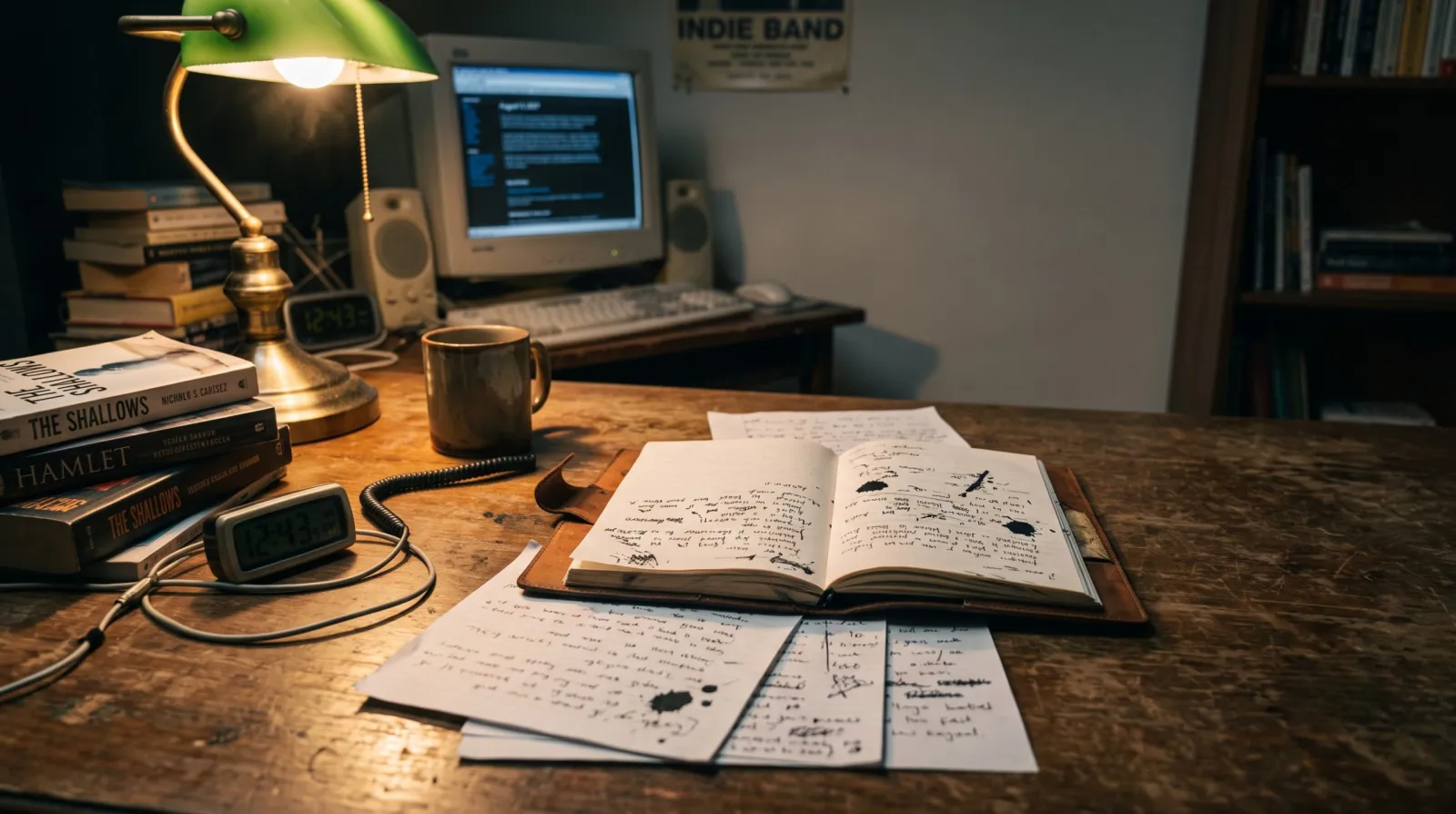
After a long time, I sat down to write again, and within the first few minutes I noticed something strange: I can’t think as well as I used to. Or rather, the thoughts are still there. There are dozens of them in my head, constantly fighting with each other, but I struggle to pull them together the way I once did and turn them into a few pages of writing. I got my coffee, sat down at the desk, and thought for a long while about what to write. I used to be able to rattle off pages about any topic that came to mind; these days, just gathering what comes to mind has become an effort in itself. Thoughts used to turn into sentences on their own. Now, before I can build a sentence, I first have to catch the thought.
Then I started thinking about why. As someone who used to read books regularly, I tried to pin down what it was that had both derailed my reading habit and slowed down my writing. As I kept thinking, a few items actually surfaced in my mind. Here they are as an unordered, incomplete list: attention spans shrinking under fast social media; forgetfulness, lack of discipline, or the absence of reward; and finally, the reverse development that has come with the rise of AI.
Maybe the problem is me. Or maybe we’re all a little like this now.
Attention spans shrinking under fast social media
First, let me explain what I mean by “fast social media.” This trend first entered our lives in 2013 with the Vine app. Back then, with this approach of watching video after video in a fast, endless loop, we didn’t realize that short, vertical video creation would come to shape how media is perceived in the future. In 2014, an app called Musical.ly carried it forward. Then came TikTok, which would become the Hiroshima of social media, spreading in China in 2016 and around the world in 2017. TikTok became the single biggest force in carrying this trend to the whole world and to every age group.
Of course, when Instagram and YouTube then copied this format for themselves, the direction of content creation and consumption changed irreversibly. Naturally, the users are happy: they have something to keep their minds busy, something that releases fake dopamine and lets them masturbate on happiness. The platforms are happy: they’re increasing how long users stay in the app. The advertisers are happy: they’ve found a new, effective way to advertise. Even adult content companies, wanting their share of all this happiness, started making 7-second porn clips. Everyone is happy. Except us, losing hours of our lives without fully understanding what’s going on.
This new kind of media has done irreversible damage to the human mind. People who at first assumed that, since this was about watching short videos, it would eat up less of their time, started finding themselves caught in a spiral that lasted for hours. Humanity was now making time for short-form content on the bus, in traffic, in the elevator, even in the bathroom. Videos that are short on their own, once linked together in an endless chain, began taking up hours, and came to occupy more of people’s lives than even sleep, one of our most basic needs.
This consumption of short content back to back, and even exposure to several pieces of content at once, has seriously lowered people’s threshold for attention and focus. As a result, people who created text-based content either moved to producing both text and video, or abandoned text-based content altogether. Because nobody reads a long piece of text anymore, and worse, nobody can find the energy to write one either. And this is where the transition to the second stage happens.
Forgetfulness, lack of discipline, or the absence of reward
As I said, the human brain now moves very fast. And related to that, forgetfulness has reached its peak. We forget almost everything. The work we’ve done, the work we’re going to do, and the promises we’ve made to ourselves. We’re surrounded by millions of people who tell themselves every New Year, “This year I’m going to do this regularly,” only to forget that promise a few weeks later. Along with this forgetfulness comes a lack of discipline. Or maybe what I think of as forgetfulness is just a lack of discipline itself. But one thing is certain: the two feed each other.
Then there’s the reward mechanism, which kicks in even for people who aren’t forgetful and are disciplined. The new system no longer rewards you. Blogs don’t make money the way they used to, and readership for written content has hit rock bottom. In a world where books are listened to rather than read, nobody reads text to learn something or to hear about a memory; they choose video instead, which appeals to the eye. I won’t lie, that’s mostly what I do too. And when I try not to, I can’t find anyone who still keeps a blog regularly these days. Maybe that’s my fault. When was the last time you read a blog? When did you last email a blog’s author? When did you last leave a comment under a post and argue with the person who wrote it? It’s rare.
On the internet of the 2000s, you’d visit a blog. You’d step into someone’s world. You’d read what they wrote, maybe leave a comment, maybe come back the next day. Maybe you’d add it to your RSS. Maybe you’d become friends with that person over the internet without ever meeting them. Now the algorithm decides who you get to see. And because algorithms favor visual content over written content, you can’t even get in front of the people who would read you. Since the system doesn’t reward you, no matter how disciplined you are, you start writing less and less often, and eventually you stop writing altogether.
And even if you manage to keep going, the final blow is dealt by LLMs, the most powerful weapons of the AI age. Who’s going to read a technical blog post when they could just learn the thing from an LLM?
The rise of AI and reverse development
We’ve come to the last item, and in my view, the biggest danger. People have started using AI even for blog posts, which I believe should be completely personal and belong to humans alone. They give it a topic, say “Write it like this,” and share content that is entirely AI-generated as if it were their own. It’s like this everywhere: on video platforms, in text-based media, in social media content. At this point, where the dead internet theory is starting to come true, a blog post full of typos and clumsy, inverted sentences is a pearl in my eyes. In this boundless pollution of artificial data, I believe the natural, neuron-based mistakes made with emotion are what’s valuable.
AI has been a very important breakthrough. If you ask me, it’s the biggest leap since the Industrial Revolution. But every revolution carries its own evil within it. People are drifting toward an era in which they won’t be able to tell whether a piece of information is true or not. Let’s keep up with the times, let’s use AI, let’s burn through millions of tokens, but let’s not surrender our souls and our reality to it. For reading a summary of something, for writing programs, for generating images, AI is a huge blessing. But at that point, I think it should remain an assistant. We shouldn’t put it in the place of a human.
For example, there’s this developer, someone I’d never heard of before, who declared himself a master once AI came along. The software he writes and the X posts he puts out (formerly known as tweets) are entirely AI-generated. He has surrendered himself completely; he’s gone blind. I’m sure he even asks AI whether people’s criticisms are valid, and what insults to throw back at them. I don’t want to name him and embarrass him, but I hope he reads this post and starts remembering that he’s human before he loses the last neuron he has left to think and question with.
Because the issue isn’t AI taking us over. The issue is us handing ourselves over to it of our own free will.
If this post has somehow landed in front of you and you’ve read it all the way to the last sentence, please know that this content is entirely the product of a human brain. I’m deliberately not fixing my typos. Things that belong to humans are beautiful even with their mistakes.
Maybe some of the sentences in this post are longer than they need to be. Maybe some of my thoughts are wrong. Maybe I’m being unfair on some points. Maybe a few years from now I’ll believe the exact opposite of what I’m arguing today. But all of it is mine. And I think that’s one of the most valuable things on the internet today. Let’s use AI to generate images, but let our ideas remain our own.
Hoping to keep writing, even if only now and then, I’ll wrap up this post that carries the spirit of 2000s blogging. If you want these posts and thoughts to continue, remember that the system has to reward them. So whichever platform you’re reading this on, please don’t hesitate to follow me there, visit my personal site, and say hello.
Because maybe the best part of blogging again is that you’re not writing for an algorithm, but directly for another human being.
Take care of yourselves.